
Somewhere between a referral bonus and a full-blown business model lies one of the internet’s most quietly powerful earning mechanisms. Affiliate marketing explained properly isn’t complicated — but most explanations either oversimplify it into a get-rich-quick fantasy or bury it under jargon. Neither serves the person who actually wants to understand how it works.
What Affiliate Marketing Actually Is
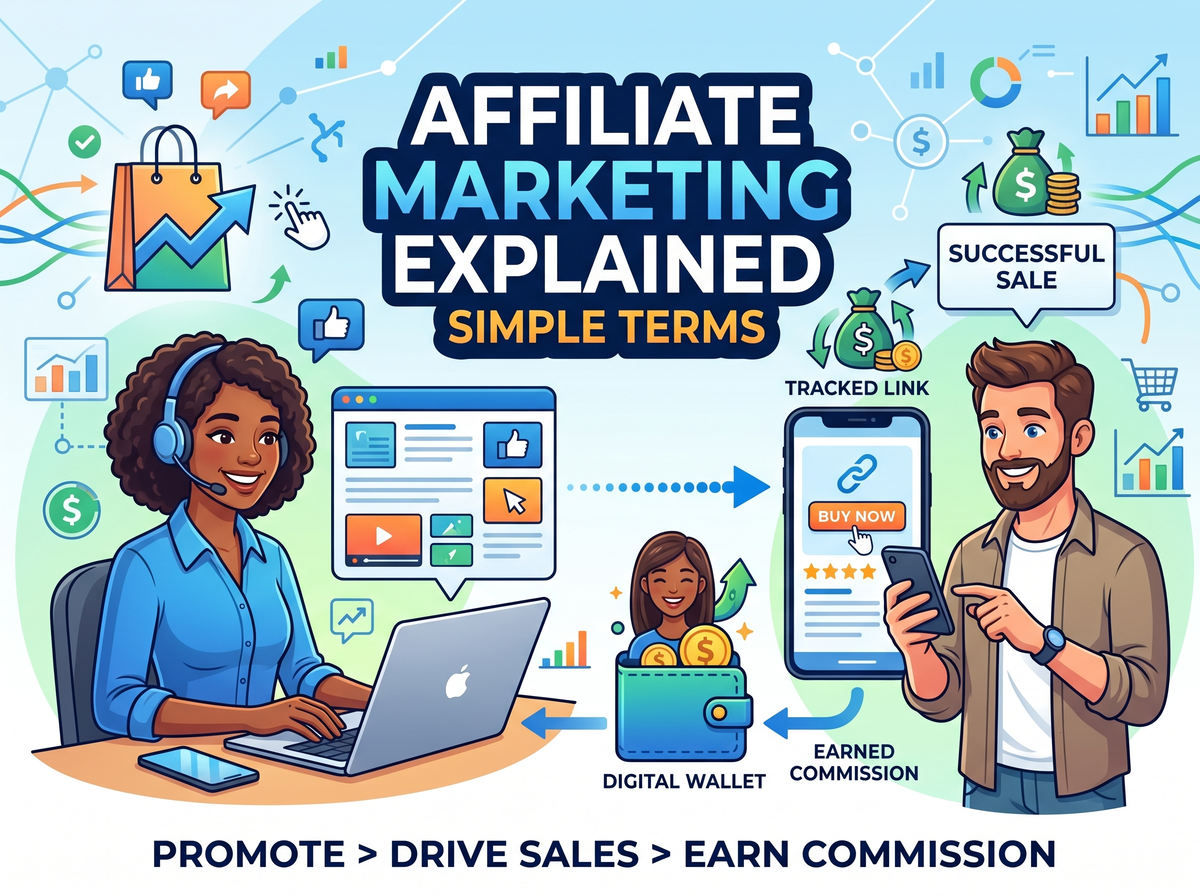
At its core, affiliate marketing is a performance-based arrangement where one party promotes another party’s product or service and earns a commission when a sale — or some other defined action — occurs. Three players are always involved: the merchant (the company selling the product), the affiliate (the person doing the promoting), and the consumer (the person who buys).
The affiliate doesn’t create the product, handle shipping, or deal with customer service. Their job is to send qualified traffic to the merchant’s offer. When that traffic converts — meaning someone clicks and then buys — the affiliate gets a cut.
This cut is tracked through a unique affiliate link. Every affiliate gets a distinct URL that records clicks and sales back to their specific account. Without this tracking mechanism, the whole system would collapse. It’s the thread that ties the commission to the person who earned it.
How the Money Actually Flows
Understanding the money side is where affiliate marketing explained clearly starts to click for most people. There are several commission structures in use across the industry.
Pay-per-sale (PPS) is the most common. The affiliate earns a percentage of the sale price whenever someone they referred makes a purchase. Amazon’s Associates program, one of the most widely used affiliate programs in the world, operates on this model — paying commissions that typically range from 1% to 10% depending on the product category.
Pay-per-lead (PPL) is common in industries like insurance, finance, and education. Here, the affiliate earns a flat fee when someone fills out a form, signs up for a free trial, or requests a quote — no purchase required. Pay-per-click (PPC) arrangements, where affiliates earn simply for driving traffic, are far rarer today than they once were, largely because they’re prone to abuse.
Commission rates vary wildly depending on the industry. Software and digital products often pay 20% to 50% because their profit margins are high. Physical goods pay less — sometimes as low as 3% to 5% — because margins are tighter. A single high-ticket software sale might earn an affiliate more than 100 physical product sales combined.
The Role of Affiliate Networks
Most people don’t negotiate directly with brands when they start out. Instead, they join affiliate networks — platforms that act as intermediaries connecting affiliates with dozens or hundreds of merchants in one place.
Networks like ShareASale, CJ Affiliate (formerly Commission Junction), and ClickBank have been running for years. They handle the tracking infrastructure, process payments to affiliates, and give merchants a pool of potential promoters to work with. For affiliates, they offer a single dashboard where commissions from multiple programs can be tracked and paid out.
Some large companies run their own in-house affiliate programs outside of networks entirely. HubSpot, Shopify, and many SaaS companies do this because they want more control over the relationship and the brand experience. These programs often pay higher commissions than network-based programs, but they require finding and applying separately.
Choosing the right program matters more than most beginners realize. A high commission rate means nothing if the product doesn’t convert, the merchant’s website is poorly designed, or the cookie window — the period during which a sale is attributed to an affiliate — is only 24 hours.
A Real-World Example Worth Walking Through
Consider someone who runs a personal finance blog. They write a detailed review comparing two budgeting apps. Within that review, they include affiliate links to both products. A reader lands on the article, clicks the link for the app they prefer, signs up for a paid plan, and the blogger earns a commission — sometimes weeks later, if the cookie is still active.
That blogger didn’t manufacture the app. They didn’t staff a support team. What they provided was context and trust — the two things most consumers need before they make a buying decision. That’s the affiliate’s real value in the transaction.
This same structure plays out across niches: travel bloggers recommending hotel booking platforms, fitness YouTubers linking to supplement brands, tech reviewers pointing audiences to gear on Amazon. The medium changes; the model doesn’t.
Common Misconceptions That Hold People Back
Affiliate marketing has a reputation problem, largely because it’s been associated with low-quality content farms and spammy email blasts. That reputation isn’t entirely undeserved — bad actors have used the model irresponsibly. But conflating the abuse of a system with the system itself is a mistake.
One persistent myth is that affiliate marketing is passive income from day one. It isn’t. Building an audience — whether through a blog, a YouTube channel, a newsletter, or a social media following — takes time and consistent effort. The passive part comes later, once that content base is established and continues generating traffic without constant updating.
Another misconception is that one needs a massive audience to earn meaningfully. A smaller, highly engaged audience in a specific niche often outperforms a large, scattered one. An email list of 2,000 people who all care deeply about home woodworking will likely convert affiliate links at a higher rate than a general lifestyle blog with 50,000 monthly visitors.
Disclosure is also frequently overlooked. In most countries, affiliates are legally required to disclose their relationships with brands when recommending products. In the United States, the FTC has clear guidelines on this. Skipping disclosures isn’t just an ethical lapse — it’s a legal risk.
What Makes an Affiliate Successful
The affiliates who build sustainable income share a few consistent traits. They choose products they genuinely believe in, because manufactured enthusiasm is obvious and erodes trust fast. They create content that solves real problems rather than just pushing products. And they treat their audience as the asset it actually is.
SEO plays a major role for content-based affiliates. Ranking a well-written, genuinely helpful article for a high-intent search term — something like “best project management software for freelancers” — can generate consistent, compounding traffic over months and years. Paid traffic can work too, but it requires careful math to ensure the commission earned exceeds the ad spend.
Email remains one of the highest-converting channels for affiliate offers. A warm, trusted subscriber relationship converts at rates that social media traffic rarely matches. Building an email list isn’t glamorous advice, but it’s consistently what separates affiliates with stable income from those riding the algorithm.
The Bigger Picture
Affiliate marketing explained at its simplest: it’s a referral system built for the internet, where the referrer gets paid based on results rather than effort. For merchants, it’s low-risk advertising — they only pay when something happens. For affiliates, it’s a way to monetize an audience or expertise without building a product from scratch.
The model has been around since the mid-1990s — Amazon launched its Associates program in 1996 — and it hasn’t faded because it works for everyone in the chain when done with integrity.
For anyone exploring affiliate marketing seriously, the clearest next step is this: pick one niche, identify two or three products within it that genuinely deserve a recommendation, and build content around helping people make informed decisions. Everything else — the commissions, the compounding traffic, the trust — follows from that foundation.