
Most people who set out to build an affiliate marketing website get it backwards. They pick a product first, slap together a site, and wonder why nobody shows up. The ones who succeed — consistently, not just once — start with a clear structure and treat the website like a business from day one.
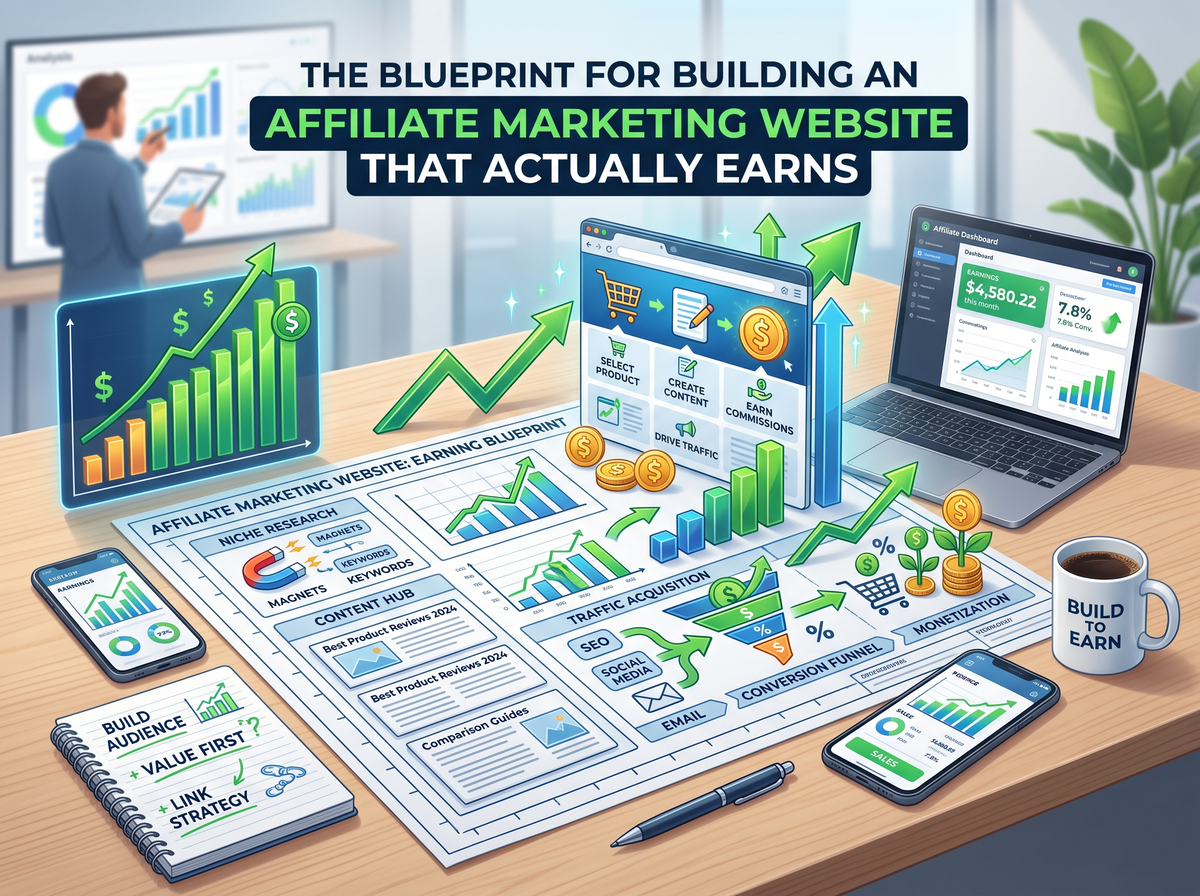
Building an affiliate marketing website isn’t complicated, but it does require doing the right things in the right order. This guide walks through exactly that.
Choose a Niche That Balances Passion With Profit
The foundation of any successful affiliate marketing website is a niche that sits at the intersection of genuine interest and commercial demand. Picking something purely because it pays well — but knowing nothing about it — leads to thin, unconvincing content that readers (and Google) can smell from a mile away.
A practical approach is to start with three or four topics one finds genuinely interesting, then pressure-test each for affiliate potential. Are there products or services people actually buy in that space? Are there affiliate programs with reasonable commission rates? A niche like “home espresso machines” has passionate buyers, multiple price points, and affiliate programs through Amazon, specialty retailers, and direct brands.
Narrow is almost always better at the start. A site about “coffee” competes with publications that have been around for decades and have full editorial teams. A site about “manual espresso brewing methods” has a fighting chance. As the site grows, the niche can expand — but launching broad is a recipe for invisibility.
Select the Right Platform and Hosting
WordPress powers a significant portion of affiliate websites for good reason. It’s flexible, well-supported, has thousands of relevant plugins, and search engines understand its structure deeply. Other platforms exist, but for someone serious about building a long-term affiliate marketing website, WordPress on a reliable shared or managed hosting account is the standard starting point.
Hosting matters more than most beginners realize. Slow load times hurt both user experience and search rankings. A provider with solid uptime, good customer support, and servers optimized for WordPress is worth the modest monthly cost. Spending fifteen dollars a month on hosting while expecting to build a real business is entirely reasonable.
Domain name selection deserves a moment of thought. Exact-match domains — like “bestcoffeegrinders.com” — can feel spammy and limit future growth. A brandable name that hints at the niche without being locked to one product category tends to age better. Think of it as naming a small publication, not labeling a product shelf.
Build the Essential Pages Before Anything Else
Before publishing a single product review, the site needs its structural foundation. This means an About page, a Contact page, a Privacy Policy, and a clear affiliate disclosure. These aren’t just legal formalities — they signal to both readers and search engines that the site is legitimate.
The affiliate disclosure deserves particular attention. The FTC in the United States requires that affiliate relationships be disclosed clearly, and similar regulations apply in many other countries. A brief, honest statement — placed in the site header, footer, or at the top of any post that contains affiliate links — keeps the site compliant and builds trust with readers who appreciate transparency.
A well-written About page can do more for conversion rates than most people expect. Readers want to know who’s recommending things to them. Even if the site is run anonymously under a brand name, a page that explains the site’s mission, editorial standards, and who the audience is for creates a sense of credibility that faceless review sites lack.
Create Content That Converts — Without Being Pushy
Content strategy for an affiliate marketing website follows a specific logic. There are essentially three types of content that drive affiliate revenue: comparison posts (“X vs. Y”), best-of roundups (“Best X for Y”), and in-depth single-product reviews. Each serves a different reader at a different point in their buying journey.
Consider a real-world example. A site focused on home office equipment might publish a roundup of the best standing desks under $500. That post targets someone early in their research. A follow-up post doing a head-to-head comparison of two specific models targets someone who’s already narrowed their choices. A detailed review of a single desk — covering setup, durability, and who it’s best for — captures the reader who’s nearly ready to buy. Together, these posts form a content ecosystem that captures traffic at multiple stages.
The writing itself needs to reflect real knowledge or real research. Vague claims like “this product is highly rated” don’t help anyone. Specific observations — dimensions, weight capacity, how it performs after six months of daily use — are what build authority and drive clicks. If the writer hasn’t used the product personally, citing verified owner reviews and manufacturer specs honestly is far better than guessing.
Drive Traffic Through SEO, Not Just Hope
An affiliate marketing website without traffic is just a hobby. Search engine optimization is the primary traffic channel for most successful affiliate sites, and it starts with keyword research before a single post is written.
Free tools like Google Search Console and Google’s autocomplete feature reveal what people are actually searching for. Paid tools like Ahrefs or SEMrush go deeper, showing search volume, keyword difficulty, and what competing pages look like. For a newer site, targeting keywords with lower competition — even if the search volume is modest — builds domain authority faster than swinging for high-volume terms that established sites dominate.
On-page SEO for affiliate content follows standard principles: the primary keyword in the title, first paragraph, at least one H2, and the URL slug. Internal linking between related posts helps search engines understand the site’s structure and keeps readers exploring longer. Page speed, mobile responsiveness, and clean site architecture aren’t optional extras — they’re table stakes.
Link building, while slower to develop, significantly accelerates ranking. Reaching out to relevant blogs for guest posts, getting listed in niche directories, or creating genuinely useful resources that others want to reference are all legitimate approaches.
Monetize Strategically — Don’t Just Paste Links Everywhere
Affiliate links placed thoughtlessly frustrate readers and underperform. Strategic placement — within the natural flow of a recommendation, in a comparison table, or in a prominent call-out box near the top of a review — consistently outperforms links buried at the bottom of a page.
Diversifying affiliate programs also protects against income disruption. Amazon Associates is the default starting point for most niches because it’s trusted and converts well, but commissions are notoriously low. Supplementing with direct brand programs, ShareASale, CJ Affiliate, or niche-specific networks often yields better commission rates for the same recommendation.
Tracking matters from the beginning. Even basic tracking — knowing which posts drive clicks and which posts drive actual conversions — reveals what’s working. A post generating thousands of visits but no conversions might have a traffic intent mismatch: the readers aren’t buyers. A post getting modest traffic but converting at 8% is worth expanding and promoting aggressively.
The Long Game: What Separates Websites That Last
Building a profitable affiliate marketing website is genuinely a long game. Most sites don’t see meaningful revenue for six to twelve months, and that’s normal, not a failure signal. The sites that endure are the ones that kept publishing useful content, kept refining their SEO, and kept building an actual audience rather than just chasing clicks.
The clearest pattern among affiliate sites that have stood the test of time is this: they treated their readers like intelligent adults. They didn’t oversell, they admitted product weaknesses, they updated old posts when products changed, and they built genuine trust over time.
Starting an affiliate marketing website in a crowded space is still viable — but only for those willing to do the unglamorous work consistently. The structural steps covered here aren’t secret. The difference is execution: picking a niche and staying focused, building a technically sound site, creating content with real depth, and driving traffic methodically. Anyone willing to commit to that process has a real path forward.