
Most people stumble into affiliate marketing with big dreams and a nearly empty wallet. Paid ads sound great — until the first campaign burns through $200 with nothing to show for it. The good news? Some of the most consistent earners in affiliate marketing built their entire business on free affiliate marketing traffic, and they did it without a single dollar in ad spend. Here’s how that actually works.
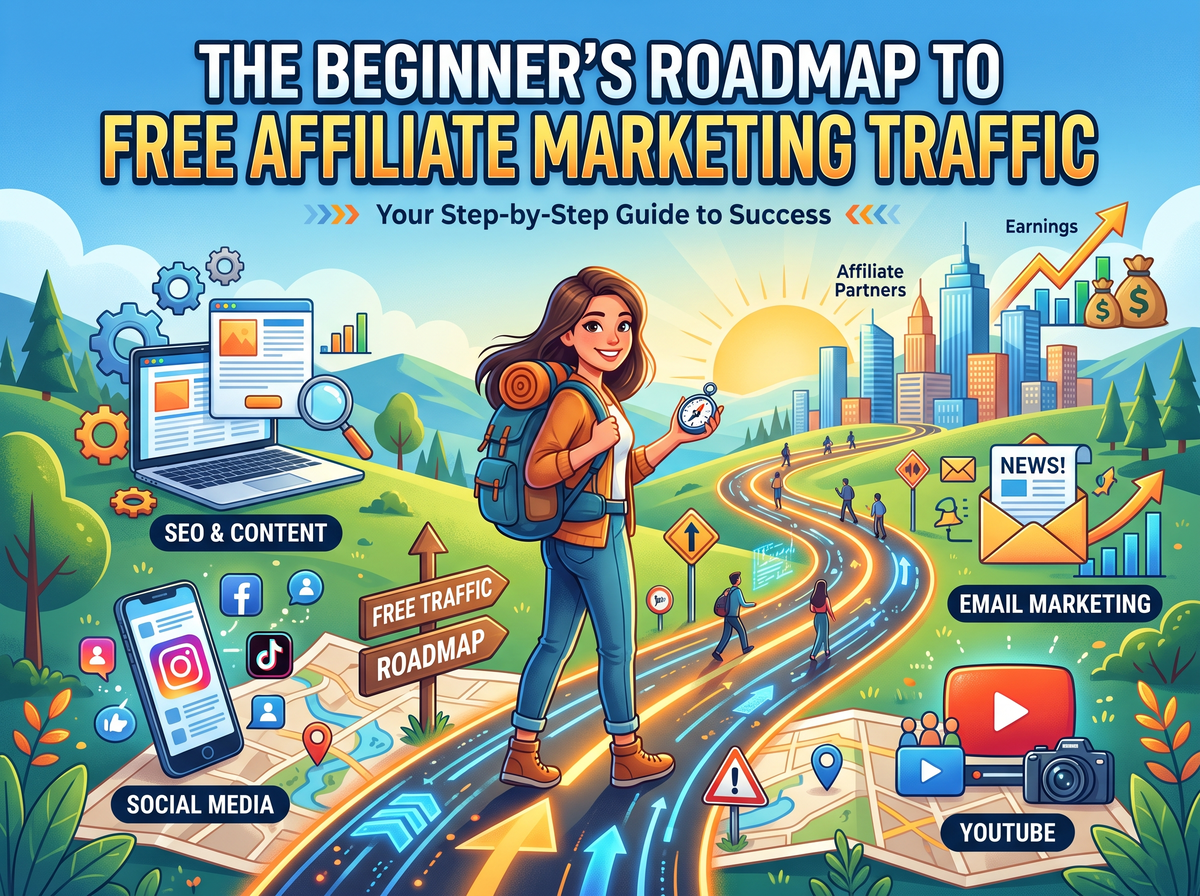
Why Free Traffic Isn’t the “Slow” Option
There’s a persistent myth that free traffic methods are for people who can’t afford “real” marketing. That framing gets it backwards. Free traffic — properly built — compounds over time. A well-ranked blog post or an evergreen YouTube video keeps sending clicks months or even years after it was created. Paid traffic stops the moment the budget runs dry.
The tradeoff is time and skill rather than money. Beginners who invest effort into learning organic strategies are essentially building an asset. A page that ranks on Google’s first page for a buying-intent keyword is worth far more than a temporary ad placement.
Consider someone like Pat Flynn, who famously built his first significant affiliate income through a free study guide website. He created content that answered real questions, ranked in search engines, and monetized through affiliate recommendations. The traffic didn’t cost him a dollar — but it required real work and genuine value.
Search Engine Optimization: The Foundation of Sustainable Traffic
For affiliate marketers, SEO remains the highest-leverage free traffic channel available. When someone types “best budget running shoes under $100” into Google, they’re moments away from a purchase decision. Ranking for that phrase means getting in front of a buyer — not just a browser.
The approach starts with keyword research. Beginners should look for low-competition, high-intent search terms. Tools like Google’s free Keyword Planner, Ubersuggest’s limited free tier, or simply mining Google’s autocomplete suggestions can surface real opportunities. The goal is finding phrases where the searcher already wants to buy or is very close to it.
Content quality determines ranking. Search engines reward pages that thoroughly answer a question, demonstrate expertise, and earn links from other sites. A beginner writing a detailed, honest comparison of two affiliate products — explaining real pros, cons, and who each is best for — will outperform thin, generic content every time. This type of review content and comparison content is the bread and butter of affiliate SEO.
On-page basics matter too: using the target keyword in the title, first paragraph, at least one H2, and the meta description signals relevance to search engines. But these are secondary to actually helping the reader.
Content Marketing Beyond Blog Posts
SEO-driven blog content is powerful, but free affiliate marketing traffic doesn’t stop there. YouTube is the second-largest search engine in the world, and it’s dramatically underutilized by affiliate beginners.
Video content has a distinct advantage: trust. Seeing a real person demonstrate a product or walk through a tutorial builds credibility faster than text alone. A beginner can create an honest “unboxing and review” video, a “how to use” walkthrough, or a “top 5” comparison — link the affiliate URL in the description — and start generating traffic with nothing more than a phone camera and decent lighting.
The same compounding logic from SEO applies to YouTube. A video that ranks for “how to set up a home office on a budget” can send traffic for years. One content creator in the personal finance niche reported that a three-year-old YouTube video still accounted for roughly 30% of their monthly affiliate commissions — created once, earning indefinitely.
Written content distributed beyond one’s own site also works. Publishing on platforms like Medium or LinkedIn Articles extends reach without requiring a website. These platforms have built-in audiences and strong domain authority, which can help content surface in search results faster than a brand-new personal blog would.
Social Media Strategies That Actually Convert
Social media is often the first place beginners try — and the first place they burn out. The mistake is treating every platform the same. Each network has a different content format, audience expectation, and traffic behavior.
Pinterest behaves more like a search engine than a social network. People search Pinterest for ideas, recipes, and product recommendations, then click through to external sites. For affiliate marketers in niches like home décor, fitness, food, fashion, or travel, Pinterest can drive meaningful organic traffic through consistent pin creation. Pins with clear, attractive images and keyword-rich descriptions get discovered repeatedly over time.
Reddit and Quora reward genuine helpfulness. These communities are notoriously resistant to obvious promotion — but they’re also full of people asking specific questions that affiliate content can answer. A beginner who spends time genuinely contributing to a subreddit or Quora topic, and occasionally links to a relevant piece of their own content where it’s appropriate and disclosed, can build real traffic and credibility simultaneously.
Short-form video on TikTok or Instagram Reels has a lower barrier to virality than almost any other channel. A single video demonstrating a product or sharing a useful tip can reach thousands of people who’ve never heard of the creator. The catch is consistency: one viral moment rarely translates to sustained affiliate income without a pattern of regular posting.
Email Lists: Turning Free Traffic Into Recurring Revenue
Here’s where most beginners leave significant money on the table. Free traffic that arrives once and leaves is wasted potential. Building an email list — even a small one — converts one-time visitors into a recurring audience.
Free email platforms like Mailchimp’s free tier or MailerLite’s basic plan allow beginners to start collecting subscribers without any upfront cost. The strategy is simple: offer something genuinely useful in exchange for an email address. A free checklist, a short guide, a resource list — something that solves a real problem for the target audience.
Once someone is on a list, the affiliate marketer can send recommendations, reviews, and valuable content directly. According to industry benchmarks, email marketing consistently outperforms social media in terms of click-through rates and conversion. The audience has opted in; they’re already interested.
A list of even 500 engaged subscribers in a focused niche can outperform a social media following of 5,000 passive ones.
Building Momentum With Consistency
Every free traffic method described here shares a common thread: none of them produce overnight results, and all of them reward consistency. The beginners who succeed aren’t necessarily the most talented writers or the most charismatic on camera. They’re the ones who show up repeatedly, improve steadily, and treat their traffic-building efforts like a long-term investment.
A realistic approach might look like this: publish two SEO-focused blog posts per week, post to Pinterest daily using a scheduling tool, engage genuinely in two or three relevant Reddit communities, and build one YouTube video per month. Done for six months, that’s a real content ecosystem — not a single shot in the dark.
Free affiliate marketing traffic is not a shortcut. But it is a legitimate, proven path that costs time rather than money — which makes it exactly the right starting point for anyone serious about building something that lasts. The next step is simple: pick one channel, commit to it for 90 days, and measure the results honestly before expanding to the next.