
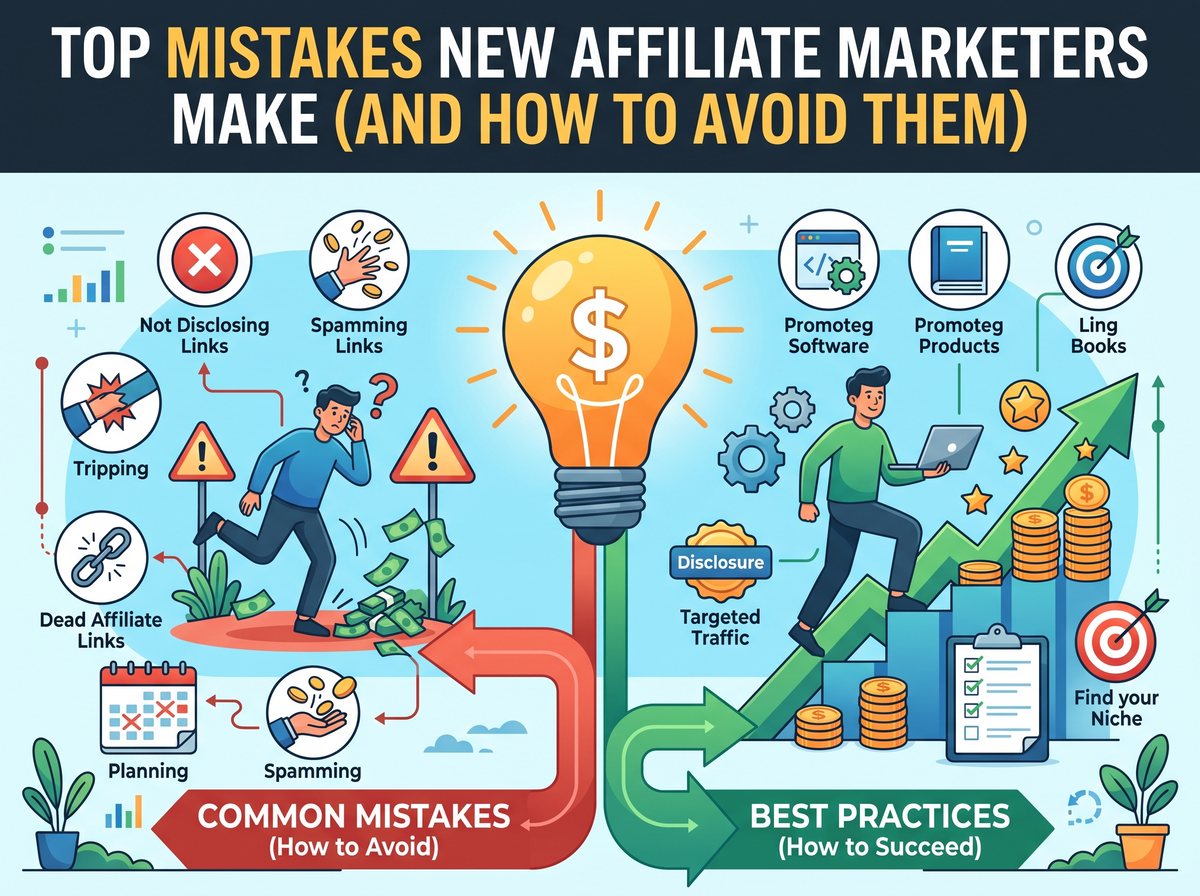
Most people who try affiliate marketing quit within three months — not because the model is broken, but because they walk in with the wrong map. The gap between “I signed up for an affiliate program” and “I’m earning consistent commissions” is littered with predictable, avoidable errors. Understanding the most common affiliate marketing mistakes isn’t just useful trivia — it’s the difference between building something that compounds over time and spinning wheels until the motivation runs out.
Chasing Commissions Instead of Solving Problems
The most widespread affiliate marketing mistake isn’t technical — it’s philosophical. New affiliates tend to start by browsing commission rates rather than thinking about what their audience actually needs. A 50% recurring commission sounds exciting, but if the product is a bad fit, no amount of clever writing will convert readers into buyers.
Consider someone who launches a personal finance blog and immediately promotes a high-ticket investment course because it pays $200 per sale. If their audience is made up of people trying to pay off credit card debt, that product is aimed at the wrong stage of the journey. The mismatch shows — in bounce rates, in low click-throughs, in silence where commissions should be.
The fix is to reverse-engineer the process. Start with a specific person’s problem, find the product that genuinely solves it, and then check whether there’s an affiliate program attached. The best affiliates think like advisors, not salespeople. That shift in mindset is what separates a content creator people trust from one they tune out.
Promoting Too Many Products at Once
There’s a temptation — especially early on — to sign up for every affiliate program in sight. It feels productive. It feels like diversification. In reality, it’s a fast path to mediocrity across the board.
When someone promotes fifteen different products in a single niche, none of them get the depth of coverage they deserve. Readers notice. A thin, drive-by mention of a tool doesn’t generate the same trust as a thorough, experience-based review. And search engines have gotten very good at distinguishing between content written to serve the reader and content written to cast a wide net.
A more effective approach is to pick two or three products that complement each other naturally and go deep. Write comparison posts, in-depth tutorials, FAQ roundups, and follow-up pieces. Build a content ecosystem around those products. One well-known affiliate in the software space built a six-figure income largely by dominating a single category — email marketing tools — rather than spreading thin across the entire SaaS landscape.
Ignoring SEO Fundamentals From Day One
Affiliate marketing and SEO are not optional partners — they are the same business for most content-based affiliates. Yet a surprising number of new marketers write content with no keyword research, no understanding of search intent, and no attention to on-page structure. They publish into the void and then wonder why the traffic never comes.
One of the most damaging affiliate marketing mistakes in this category is targeting keywords that are either too competitive or too vague. Writing a post called “Best Laptops” when you have a brand-new site with zero domain authority is the content equivalent of opening a sandwich shop across the street from a McDonald’s. The odds aren’t in your favor.
The smarter play is to start with long-tail, lower-competition keywords — phrases that signal clear buying intent, like “best laptop for nursing students under $700” or “lightweight laptop for travel 2024.” These bring in smaller volumes, but the readers who land on those pages know what they want. Conversion rates for hyper-specific queries tend to be significantly higher than for broad ones. Building authority incrementally, rather than swinging for the fences immediately, is what creates a sustainable foundation.
Neglecting Content Quality for Volume
Speed is seductive. The logic goes: publish more, rank more, earn more. And while consistency matters, volume without quality is a trap that has gotten worse, not better, over time. Search engine algorithm updates over the past few years have made it increasingly difficult for thin content to hold rankings — and the sites that leaned too hard into quantity are the ones that got hit hardest.
New affiliates often underestimate how much effort goes into a piece of content that actually earns trust. A genuinely useful product review isn’t just a list of features lifted from the product page. It addresses real objections, shares honest drawbacks, explains the exact type of person who would benefit, and gives the reader confidence in their decision.
Quality also pays off in ways that compound. A well-researched article earns backlinks organically. It gets shared. It holds its position in search results longer. One piece of genuinely excellent content can outperform ten mediocre ones over a twelve-month window. The math, counterintuitively, favors depth.
Failing to Disclose Affiliate Relationships
This one isn’t just a strategic error — it’s a legal one. The FTC in the United States (and similar regulatory bodies in other countries) requires that affiliate marketers clearly disclose when they have a financial relationship with a brand they’re recommending. Failing to do so isn’t a gray area. It’s non-compliance.
Beyond the legal requirement, transparency is simply good business. Readers are more sophisticated than many marketers give them credit for. When someone sees a genuine, clear disclosure at the top of a review — something like “This post contains affiliate links, which means I may earn a commission if you purchase through them” — it doesn’t destroy trust. Research consistently shows that readers appreciate the honesty and are still highly likely to click through when the recommendation is credible.
What erodes trust is when readers feel manipulated. When the disclosure is buried, hidden in a footer, or absent entirely, and the reader figures it out anyway, the damage is lasting. Building an affiliate business on a foundation of transparency isn’t just ethical — it’s the longer-term winning strategy.
Giving Up Before the Compounding Kicks In
Affiliate marketing has a painful early phase. For the first three to six months — sometimes longer — the results can feel completely disproportionate to the effort. Someone might publish twenty articles, build out a proper site, and earn eleven dollars. That moment is where most new affiliates decide the whole thing is a scam and walk away.
The compounding nature of content-based affiliate income means the returns are back-loaded. Articles written in month two might not start ranking meaningfully until month eight. The trust signals that search engines use take time to accumulate. The affiliates who quit at month four never see what month ten looks like.
The antidote to early discouragement isn’t false optimism — it’s tracking leading indicators instead of lagging ones. Are organic impressions growing? Are click-through rates improving? Is the site accumulating any backlinks? These signals tell a different story than revenue alone, and they give a realistic picture of whether the trajectory is moving in the right direction.
The Through-Line in Every Affiliate Marketing Mistake
Look across all of these affiliate marketing mistakes and a single thread connects them: short-term thinking. Chasing the highest commissions, flooding the site with low-effort content, skipping the fundamentals, giving up before compounding — they all stem from prioritizing what feels productive now over what actually builds something durable.
The affiliates who eventually break through aren’t necessarily the most talented writers or the most technically sophisticated marketers. They’re the ones who commit to solving real problems for real people, stay consistent through the quiet early months, and treat the work like a business rather than a lottery ticket.
Anyone entering this space should audit their current approach against these categories. If one of them resonates more than the others, that’s the place to start. Fixing the right problem, specifically and immediately, is worth more than any amount of general inspiration.